
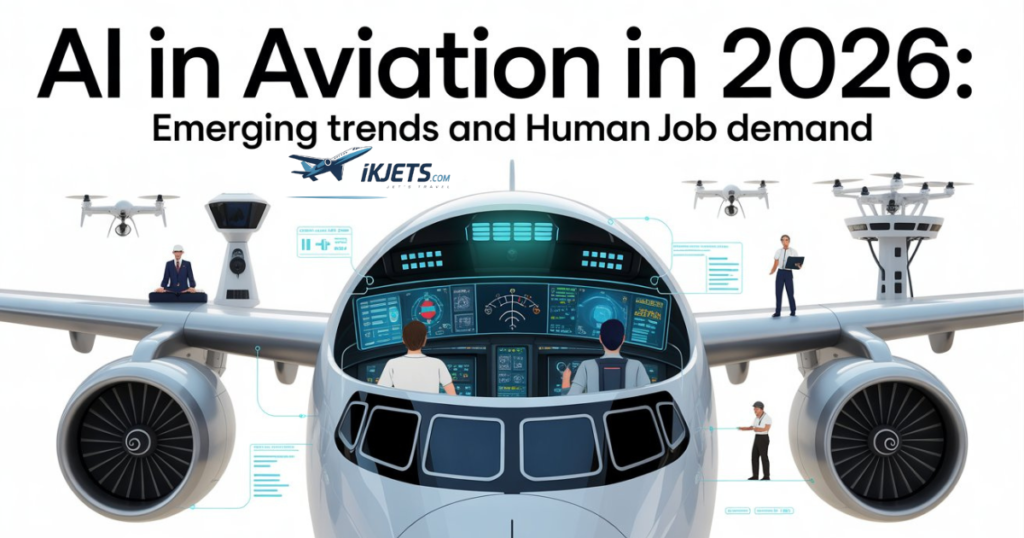
Summary : The concept of Ai in aviation is transforming the way airlines, maintenance crews, and pilots operate. From autonomous aircraft systems to AI-enabled flight operations, technology is redefining efficiency and safety. Today, aviation is exploring applications like flight deck AI, predictive aircraft maintenance, and AI-powered airline scheduling, promising faster, safer, and smarter skies. The rise of autonomous drones and eVTOL and self-flying aircraft is no longer science fiction. Experts predict a gradual, but inevitable, integration of AI into daily aviation operations.
However, introducing AI brings challenges. Regulators are working to ensure AI regulatory compliance in aviation, while airlines and maintenance providers explore the potential of aviation workforce transformation. Safety remains the top priority, with aviation safety management systems and safety-critical AI applications becoming essential tools. Machine learning in aerospace now powers insights from vast amounts of operational data, helping pilots, technicians, and planners make better decisions.
Table of Contents
The Role of AI in Modern Aviation
Ai in aviation in aviation is streamlining operations like never before. With AI-enabled flight operations, airlines can optimize routes using AI-powered route optimization. Aircraft predictive analytics helps track performance and predict failures before they happen, reducing downtime. Even minor improvements in efficiency can save millions of dollars annually while improving reliability.
AI is also changing maintenance. Aviation maintenance optimization allows technicians to plan repairs and inspections based on predictive aircraft maintenance data. This reduces human error and improves safety. Meanwhile, flight autonomy systems and uncrewed aircraft are being tested for cargo delivery, expanding operational possibilities and demonstrating the future potential of autonomous cargo helicopters and self-flying aircraft.
Transforming Flight Deck Operations
The cockpit is no longer just a human domain. Flight deck AI assists pilots in monitoring instruments, optimizing flight paths, and preventing errors. Systems can analyze weather data, air traffic, and aircraft performance simultaneously. This reduces workload and allows pilots to focus on critical decision-making.
Human-AI collaboration is essential. Human-AI collaboration in aviation ensures that pilots and AI systems complement each other. Trust and shared understanding are developed through simulation-based training and real-world exercises. Together, humans and AI enhance safety, efficiency, and situational awareness.
Enhancing Safety and Efficiency
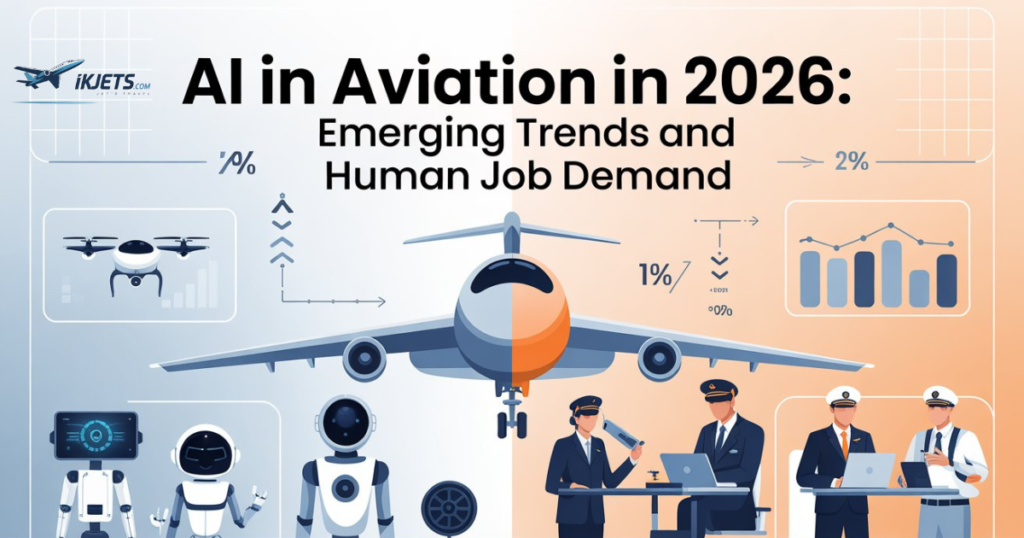
Safety is the foundation of aviation. Aviation safety management systems integrate AI to identify risks, predict incidents, and streamline emergency responses. AI decision support systems guide personnel in maintenance planning and operational decisions. Airlines have reported fewer delays, reduced fuel usage, and improved on-time performance thanks to these systems.
Efficiency also improves through digital operations in aviation. Scheduling flights, assigning crews, and managing traffic in congested airspace is now powered by AI-powered airline scheduling. Airlines such as American Airlines and Lufthansa are using AI to reduce turnaround times and enhance passenger satisfaction.
Human-AI Collaboration in the Cockpit
Humans and AI bring unique strengths. Pilots offer adaptability and judgment. AI provides consistent data analysis and rapid decision-making. Machine learning in aerospace allows AI to identify anomalies in real-time, complementing human intuition.
Shared mental models are key. Human-AI collaboration in aviation relies on defined roles and responsibilities. Pilots remain the ultimate decision-makers, while AI handles repetitive, data-heavy tasks. Together, they ensure safer and more efficient operations.
Complementing Pilot Skills
AI assists with monitoring instruments, navigation, and weather assessment. Pilots no longer perform repetitive calculations manually. This reduces fatigue and increases accuracy. Systems like flight deck AI integrate seamlessly with traditional controls, allowing humans to intervene when needed.
AI also helps in training. Simulation systems can replicate real-world conditions. Pilots practice unusual scenarios in safe environments. This combination of technology and experience ensures readiness for emergencies while autonomous drones and eVTOL gradually demonstrate autonomy in controlled conditions.
Trust and Shared Mental Models
Trust is crucial. Airlines are deploying Ai in aviation support systems to validate AI suggestions before acting. Pilots learn to trust AI only after repeated, accurate performance. Regulatory bodies like the FAA emphasize human oversight as a necessary layer in AI integration.
Shared understanding also extends to operations. Teams must know how AI arrives at conclusions. Transparent aircraft predictive analytics improves trust while allowing better collaboration between humans and machines.
AI-Powered Flight Operations and Scheduling
Flight operations are becoming data-driven. AI-powered airline scheduling helps match aircraft, crew, and routes efficiently. AI analyzes weather, traffic, and passenger demand simultaneously, optimizing schedules to prevent delays.
Maintenance also benefits. Predictive aircraft maintenance uses AI to track components and predict failures. Airlines save money and reduce downtime by acting before issues escalate. Aviation data analytics ensures informed decisions, improving aviation operational efficiency across fleets.
Predictive Maintenance
Predictive maintenance allows airlines to replace parts before they fail. AI analyzes historical performance, flight conditions, and mechanical wear. This reduces safety risks and operational costs, increasing reliability for passengers and cargo operators.
Technicians use AI decision support systems to prioritize tasks. Even complex repairs are guided by ED-324 aviation standard practices, ensuring compliance while leveraging AI for efficiency.
Crew and Route Optimization
AI helps schedule crews in compliance with regulations. Ai in aviation route optimization minimizes fuel use and avoids congested airspace. Airlines can reduce costs while maintaining safety. Cargo operators benefit from autonomous cargo helicopters to deliver goods more efficiently, complementing traditional flights.
Key Innovations by Airlines in AI Adoption
Airlines are testing cutting-edge AI tools. American Airlines uses AI to rebook passengers and prevent delays. Lufthansa deploys AI cameras for faster turnarounds, and Korean Air upgrades its cloud systems for AI-enabled flight operations.
These innovations highlight how AI enhances aviation operational efficiency. They also set standards for other airlines to adopt autonomous aircraft systems safely, proving that data-driven decision-making can revolutionize air travel.
AMERICAN AIRLINES Rebooking System
AI predicts delays and automatically adjusts passenger connections. This improves customer satisfaction while reducing staff workload. The system integrates with air traffic management systems to coordinate schedules efficiently.
Korean Air’s Cloud Overhaul
By migrating to cloud-based AI, Korean Air enables aviation data analytics across its fleet. Flight paths, maintenance schedules, and crew planning are optimized in real-time, ensuring operational efficiency and safety.
Lufthansa’s AI Cameras
AI cameras monitor ground operations to speed up aircraft turnarounds. Errors are flagged instantly, preventing delays. This use of AI decision support systems ensures that safety standards remain intact while improving efficiency.
The Future of Electric and Autonomous Aircraft
NASA’s X-57 Maxwell is leading the charge for electric flight. Autonomous aircraft systems allow testing of efficient, emission-free flight. Small planes and cargo aircraft will be first to adopt autonomous operations, paving the way for self-flying aircraft.
Ai in aviation like uncrewed aircraft and autonomous drones and eVTOL are expanding rapidly. Cargo operations will likely see full autonomy first, while passenger aircraft adoption is constrained by safety and regulatory hurdles.
NASA X-57 Maxwell
The X-57 tests electric propulsion and AI-assisted control. Flight data informs future flight deck AI designs, ensuring integration into certified aircraft meets FAA AI guidelines.
Autonomous Flight Trends
Self-flying aircraft are in development for logistics and emergency response. AI-enabled flight operations allow safe, precise, and efficient flight paths. Combined with aviation workforce transformation, these technologies redefine traditional roles.
AI’s Impact on Aviation Safety and Security
AI helps identify risks and mitigate threats. Aviation safety management systems integrate safety-critical AI applications to detect anomalies and prevent accidents. Airlines also use aviation cybersecurity and AI to protect systems from cyberattacks.
Operational safety is enhanced through digital operations in aviation. Predictive insights prevent equipment failure, while AI monitors both ground and flight operations. These measures are vital as self-flying aircraft become more prevalent.
Cybersecurity Measures
AI constantly monitors networked systems for threats. Airline systems are safeguarded using aviation data analytics and automated detection tools. Threats are flagged in real-time, reducing risk.
Risk Mitigation Frameworks
Ai in aviation potential operational hazards and helps design mitigation strategies. From flight planning to maintenance, AI decision support systems enhance aviation operational efficiency while maintaining compliance with regulatory aviation standards.
Regulatory and Policy Challenges in AI Aviation
Regulators are cautious. FAA AI guidelines and EASA AI roadmap outline steps to safely integrate AI. Standards like ED-324 aviation standard provide frameworks for AI use in aircraft and ground systems.
Global policy coordination remains a challenge. AI technology evolves faster than rules. Airlines must adopt AI-enabled flight operations carefully, ensuring safety and compliance with regulatory aviation standards.
FAA Oversight and AI Standards
The FAA evaluates AI in maintenance, flight operations, and decision-making support. AI regulatory compliance in aviation is mandatory before full autonomy is allowed. This includes testing, verification, and validation under strict protocols.
Global Policy Coordination
International coordination ensures consistent safety rules. Bodies like EUROCAE publish guidelines for machine learning in aerospace, enabling safe integration of autonomous aircraft systems across borders.
Strengths and Limitations of AI vs Humans
Humans excel at adaptability, judgment, and managing unexpected situations. AI shines at processing large datasets and performing repetitive tasks with precision. Combined, they increase aviation operational efficiency while reducing errors.
Machine learning in aerospace improves prediction accuracy. However, AI lacks intuition, requiring humans for final decision-making. Human-Ai in aviation in aviation balances these strengths, ensuring safer skies.
Human Decision-Making and Adaptability
Pilots respond to unforeseen conditions like severe weather or equipment malfunctions. AI provides insights but cannot fully replace human judgment. AI decision support systems enhance human decision-making without removing accountability.
AI’s Predictive Power and Consistency
AI analyzes historical data to predict failures and optimize operations. Predictive aircraft maintenance and AI-powered route optimization reduce costs and improve safety, complementing human expertise in the cockpit.
Training for the AI-Integrated Flight Deck
Simulation-based learning allows pilots to train with flight deck AI in controlled environments. Human operators gain experience in AI-enabled flight operations, preparing for real-world challenges.
Continuous skill development ensures adaptability. As autonomous drones and eVTOL and self-flying aircraft emerge, training programs evolve to include AI oversight, predictive analytics, and safety protocols.
Simulation-Based Learning
AI simulations mimic real flight conditions. Pilots practice emergency responses and interact with AI systems. Flight autonomy system scenarios help prepare humans for future autonomous operations.
Continuous Skill Development
Learning never stops. Operators maintain expertise in traditional flight skills while adapting to AI-supported processes. Aviation workforce transformation ensures the industry evolves alongside technology.
The Economics of AI in Aviation
AI adoption saves costs by optimizing aviation maintenance optimization, crew scheduling, and flight operations. Airlines see improved aviation operational efficiency, reduced fuel use, and faster turnaround times.
Investment in AI technologies supports long-term growth. Predictive maintenance, AI-powered airline scheduling, and aviation data analytics generate measurable ROI while preparing airlines for autonomous aircraft systems integration.
Cost Savings and Efficiency Gains
AI minimizes human errors, predicts equipment failure, and improves scheduling. Airlines report significant reductions in downtime and maintenance expenses.
Investment in AI Technologies
Companies invest in AI research, cloud infrastructure, and digital operations in aviation platforms. These tools support safety-critical AI applications and AI-enabled flight operations across fleets.
Ethical Considerations and Job Demand
AI raises ethical questions about replacing pilots or maintenance staff. Aviation workforce transformation emphasizes retraining rather than replacement. Humans remain essential for oversight and safety assurance.
Automation changes roles but does not eliminate them. AI assists humans in decision-making and routine tasks, allowing the workforce to focus on complex problem-solving while AI handles predictive aircraft maintenance and AI decision support systems.
Pilot Workforce Evolution
Pilots gradually shift from hands-on flying to managing AI systems. Training includes human-AI collaboration in aviation and supervisory roles over self-flying aircraft.
Balancing Automation with Human Roles
AI complements rather than replaces human expertise. Safety-critical AI applications support humans while maintaining accountability and trust in aviation operations.
Research Directions and Emerging Trends
AI-human teamwork research is expanding. Studies on human-AI collaboration in aviation explore optimal task allocation, trust, and system integration. Flight deck AI and AI-powered airline scheduling are primary research areas.
Emerging trends include autonomous cargo transport, eVTOL taxis, and AI-enabled flight operations for predictive maintenance and air traffic management. Aviation data analytics is central to these developments.
Conclusion
The integration of artificial intelligence in aviation is reshaping the skies. From autonomous aircraft systems to AI-enabled flight operations, airlines are improving aviation operational efficiency, safety, and reliability. Flight deck AI, AI-powered airline scheduling, and predictive aircraft maintenance are already transforming how crews, technicians, and planners work. While challenges remain in AI regulatory compliance in aviation and public trust, the potential benefits are undeniable. The collaboration between humans and AI, guided by FAA AI guidelines, EASA AI roadmap, and standards like ED-324 aviation standard, ensures that technology enhances operations without compromising safety. Over the next decade, expect self-flying aircraft, autonomous drones and eVTOL, and advanced AI decision support systems to become integral parts of both passenger and cargo aviation, ushering in a safer, smarter, and more efficient future.
FAQs
What is the role of AI in aviation today?
AI supports AI-enabled flight operations, predictive maintenance, and AI decision support systems, improving aviation operational efficiency and reducing human error in both commercial and cargo aviation.
Are there self-flying aircraft currently in operation?
Currently, self-flying aircraft are mainly in testing and cargo applications. Human pilots remain critical, while autonomous systems assist with monitoring and predictive analytics.
How does AI enhance aviation safety?
Aviation safety management systems use AI to monitor performance, detect anomalies, and prevent incidents. Safety-critical AI applications provide real-time insights without replacing human oversight.
What are the regulatory standards for AI in aviation?
AI in aviation must comply with FAA AI guidelines, EASA AI roadmap, and standards like ED-324 aviation standard. These frameworks ensure safe and reliable integration of autonomous aircraft systems.
Will AI replace pilots in the future?
AI is expected to complement pilots rather than replace them. Human-AI collaboration in aviation ensures humans remain in control while AI handles repetitive.